
BRIEFING · JUNE 2026
The Regulatory Reality & Options for non-EU placement firms

MANAGING DIRECTOR - NEMOS
Till Tolksdorf
A brief overview for placement agents on why third-party marketing into the EU requires a regulated distribution structure, and which solutions for a regulated distribution exist.
OVERVIEW
For much of the past decade, third-party marketing into the EU operated in what many placement agents treated as a grey area. Enforcement varied significantly across member states, pre-marketing rules were not harmonised, and reverse solicitation was often applied as a general workaround rather than the narrow exemption it was intended to be. A substantial number of non-EU placement agents built active EU practices without holding any EU authorisation, and in the absence of visible enforcement, this approach carried limited apparent risk.
That environment has shifted. The Cross-Border Distribution of Funds (CBDF) framework tightened the definition of pre-marketing and narrowed reliance on reverse solicitation across the EU. National regulators, including BaFin, CSSF, and AFM, have become more active in reviewing distribution chains directly, rather than assessing fund-level compliance alone. At the same time, fund managers face growing pressure from their own investors and regulators to evidence that their distribution partners operate on a compliant basis - making a placement agent's licensing status a factor in mandate selection rather than a background consideration.
This matters for placement agents in three concrete ways. Regulatory exposure has moved from theoretical to actionable, as national regulators now pursue unlicensed distributors directly rather than relying solely on fund-level enforcement. The commercial cost of remaining unregulated is increasing, as licensing status becomes part of how fund managers evaluate distribution partners. And fee arrangements tied to unlicensed marketing activity carry a legal risk that received little attention historically, but is now more likely to surface, particularly where a mandate or fee is disputed.
The sections below set out four considerations relevant to placement agents evaluating how to structure their EU marketing activity.
The Regulatory Reality
Reverse solicitation has a narrow scope
Reverse solicitation exempts marketing activity only where the approach is initiated exclusively by the investor, without any preceding contact, encouragement, or facilitation from the fund manager, the placement agent, or any third party acting on their behalf. It is not a matter of degree - the initiation must be wholly and demonstrably reverse. Since the Cross-Border Distribution of Funds framework tightened this definition, any prior marketing contact, including informal, preliminary, or indirect outreach, voids reliance on the exemption for that investor relationship, regardless of who ultimately initiated the resulting subscription. In practice, this means reverse solicitation cannot be used as a distribution strategy, planned around, or relied upon as a fallback for agent-driven outreach; it applies only to the narrow case of a genuinely investor-originated approach, with no prior solicitation of any kind by the manager, the agent, or any party connected to them.
The authorisation sits with the distributor
An AIF's marketing passport under AIFMD authorises the fund manager to market a specific fund into specified EU member states. It does not authorise the placement agent conducting the day-to-day marketing activity. Sourcing investors, making introductions, and taking subscription instructions typically qualify as investment services under MiFID II - reception and transmission of orders, placement, or advice - and performing these as a business requires the agent's own authorisation, or a tied-agent relationship with an authorised firm.
Licensing factors into agent selection
Fund managers conducting due diligence on placement partners increasingly review the partner's regulatory status as part of that assessment. A placement agent operating without a clear licensing basis introduces distribution-chain risk for the manager, independent of the agent's track record or investor network. Demonstrating a properly licensed distribution structure is therefore a factor in being considered for higher-quality mandates, alongside commercial track record.
Fee enforceability depends on licensing
Placement fees are generally tied to the performance of a regulated activity - the introduction or placement of investors into a fund. Where that underlying activity was not properly authorised, the enforceability of the associated fee arrangement is exposed to legal risk. This is a separate question from whether the fee was commercially agreed; enforceability depends on whether the activity generating it was conducted in compliance with the law.
Options for non-EU placement firms
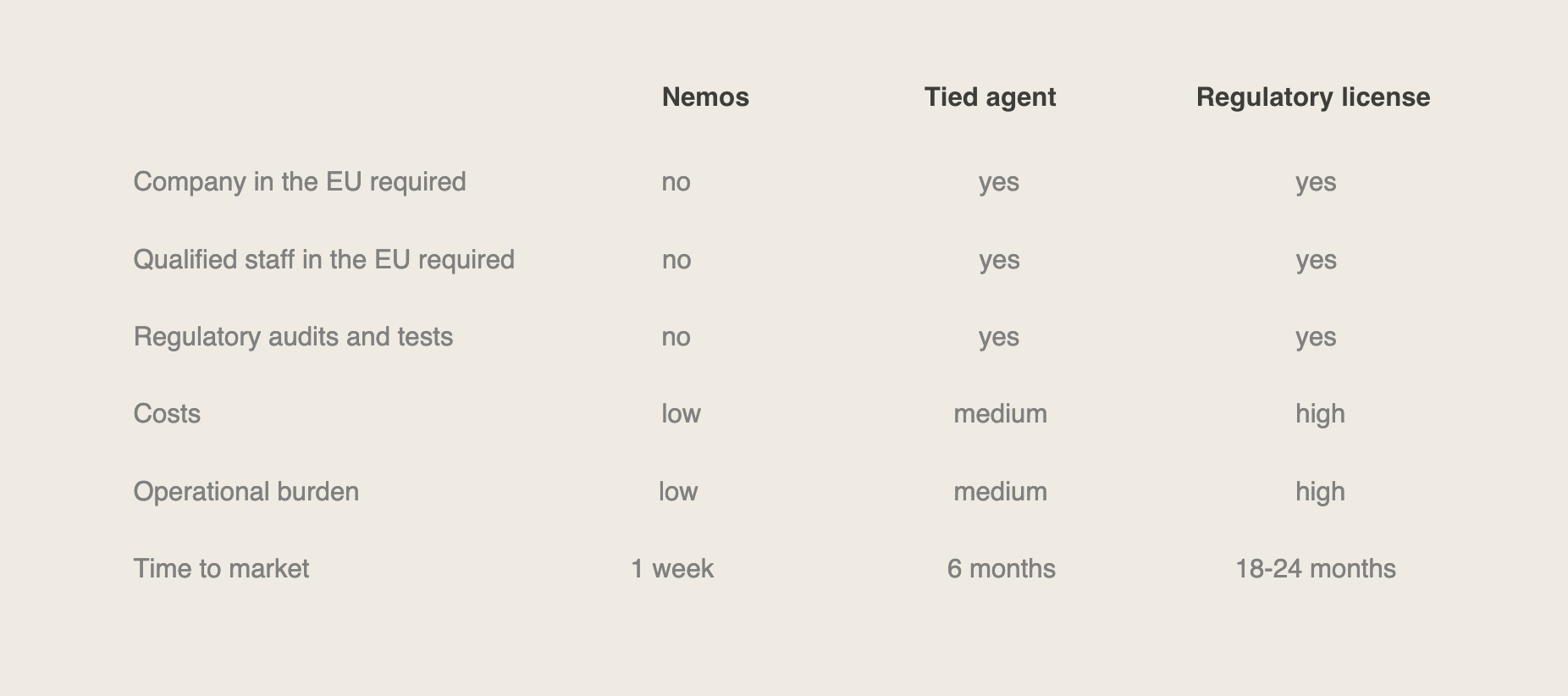
Non-EU placement firms have three options for carrying out their activities on a fully regulated basis: becoming a tied agent under a regulatory umbrella within the EU, becoming a fully regulated entity licensed by one of the European financial supervisory authorities, or using a setup like Nemos. The table below sets out the advantages and disadvantages of each.
SPEAK WITH US
Interested in more?
IMPORTANT NOTICE
Disclaimer
This document has been prepared by Nemos Regulatory Solutions GmbH for general informational purposes only. It does not constitute legal, regulatory, tax, financial, or investment advice, and should not be relied upon as such. Nothing in this document creates or shall be construed as creating an advisory, client, or fiduciary relationship between Nemos Regulatory Solutions GmbH and the recipient.
The information reflects a general summary of selected regulatory considerations as of the date of preparation, may not reflect subsequent legal or regulatory developments, and does not account for the specific facts and circumstances of any individual recipient. Recipients should seek independent professional advice before taking, or refraining from taking, any action based on the contents of this document. Nemos Regulatory Solutions GmbH accepts no liability for any loss or damage arising, directly or indirectly, from reliance on this document.
Nemos Regulatory Solutions GmbH is a tied agent within the meaning of Section 3 (2) of the German Securities Institutions Act (WpIG) and acts exclusively on behalf of and under the liability of the securities institution Concedus GmbH, Nuremberg, when brokering financial instruments (securities, asset and capital investments, etc.). Nemos Regulatory Solutions GmbH is registered with BaFin as a tied agent. BaFin register of tied agents (register number 80181244).